The Quartered Spanish Standard
/vexillology/atlas/spanish_standard
About
Three charts in this collection — Paris 1837, New York c. 1864, and the American sheet of c. 1899 — print a “Spanish Standard” that is not a field bearing arms but a whole flag made of arms: royal quarterings spread edge to edge, repeated among the three nearly stroke for stroke. The design is a fixture of the chart tradition and almost invisible outside it. Standard modern references, including the usual encyclopaedic accounts of Spanish flags, pass over it. This page collects the depictions, describes the composition, and states the open question.
Status: Preliminary. The identifications of individual quarterings below are observational and tentative; the search for the design's documentary source is the point of the page.
Documented Comparison
The documented royal flags of Spain in the charts' own period were of a different kind: the royal arms borne on a plain field, as the c. 1720 Homann panel in this collection correctly shows, the crowned arms within the collar of the Golden Fleece on white, in the form of the Bourbon marine standard. Nothing in the ordinary nineteenth-century record prescribes a standard quartered across the whole sheet.
The composition finds its parallels much earlier. Royal standards of the sixteenth and seventeenth centuries commonly displayed the sovereign's greater arms across the entire cloth, and the greater arms of the Habsburg kings of Spain held exactly the elements the charts draw: Castile and León, the pales of Aragon, the Aragon-Sicily saltires, the bendy of Burgundy, the black quarter with the golden lion of Brabant, the small lion of Flanders, and, between 1580 and 1640, the escutcheon of Portugal.
The Composition
As drawn on the 1837 sheet and repeated by the two American charts, the flag reads roughly as follows: a canton quartering Castile and León, castles and lions; the pales of Aragon; saltire-quarters bearing eagles, which match the arms of Aragon-Sicily; a horizontal band of red and white; a row of red and white compartments, which the 1864 chart alone fills with small crowns; the bendy of Burgundy; a black quarter with a golden lion, matching Brabant; and a yellow quarter with small beasts that suggest Flanders and Tyrol. At the centre of the flag stands an escutcheon, and beneath it a small blue shield of fleurs-de-lis (Anjou, and so Bourbon) that all three charts draw.
That central escutcheon is the most interesting element in the design and the least stable across the three sheets. The c. 1864 chart states it plainly: a white shield bearing five small blue shields arranged in cross, each charged with dots, which is the quinas of Portugal drawn well enough to be named. The 1837 sheet, otherwise much the finer engraving, gives only the frame — a white shield within a red bordure, the charges left blank by this copy's colourist. By c. 1899 the five shields have flattened into five plain squares. The design does not, then, simply decay with age: the clearest statement of the key quarter falls in the middle of the chain, and the sheet that draws the rest most carefully is the one that leaves this quarter empty.
If the Portugal reading holds, the model behind the chart-tradition standard would date at least in part to the union of the crowns, which would mean a flag of c. 1580–1640 still being copied in 1899. It is offered as a hypothesis to test rather than a conclusion. Engravers garble, colourists fill in what they half recognize, and a shield of five charges admits other readings.
Collected Depictions
| Source date | Source | Printed attribution | Type | Study |
|---|---|---|---|---|
| c. 1720 | Flaggen aller seefahrenden Potenzen und Nationen | Königl: Spanische | Arms on white | Note below |
| 1837 | Pavillons et Cocardes | Espagne — Pavillon Royal | Quartered sheet | Note below |
| c. 1864 | Johnson's New Chart of National Emblems | Spanish Standard. | Quartered sheet | Note below |
| c. 1899 | Flags of All Nations | Spain (Standard) | Quartered sheet | Note below |
Note: the c. 1720 Depiction
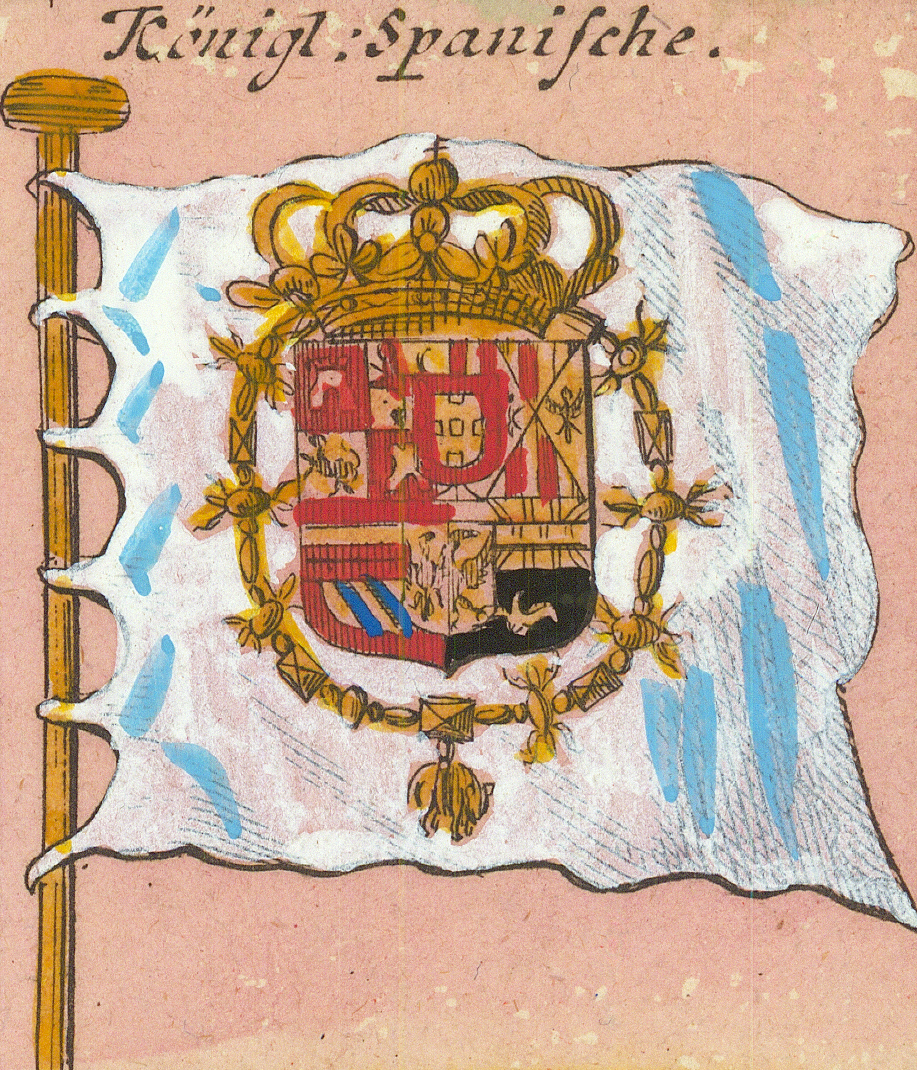
The Homann sheet shows the other, documented type: the crowned royal arms within the collar of the Golden Fleece on a white field. It stands on this page as the control, showing what a royal Spanish flag of the period looked like in respectable contemporary record, and as evidence that the quartered sheet of the later charts is not simply what charts always drew.
It is also more than a control. The shield inside the collar carries much the same quarterings the later charts spread across the whole cloth — Castile and León, the pales of Aragon, the bendy of Burgundy, the black quarter, the small beasts — so what separates the two types is not the heraldry but the format. In 1720 the arms are on the flag; in the later charts the arms are the flag.
Note: the 1837 Depiction
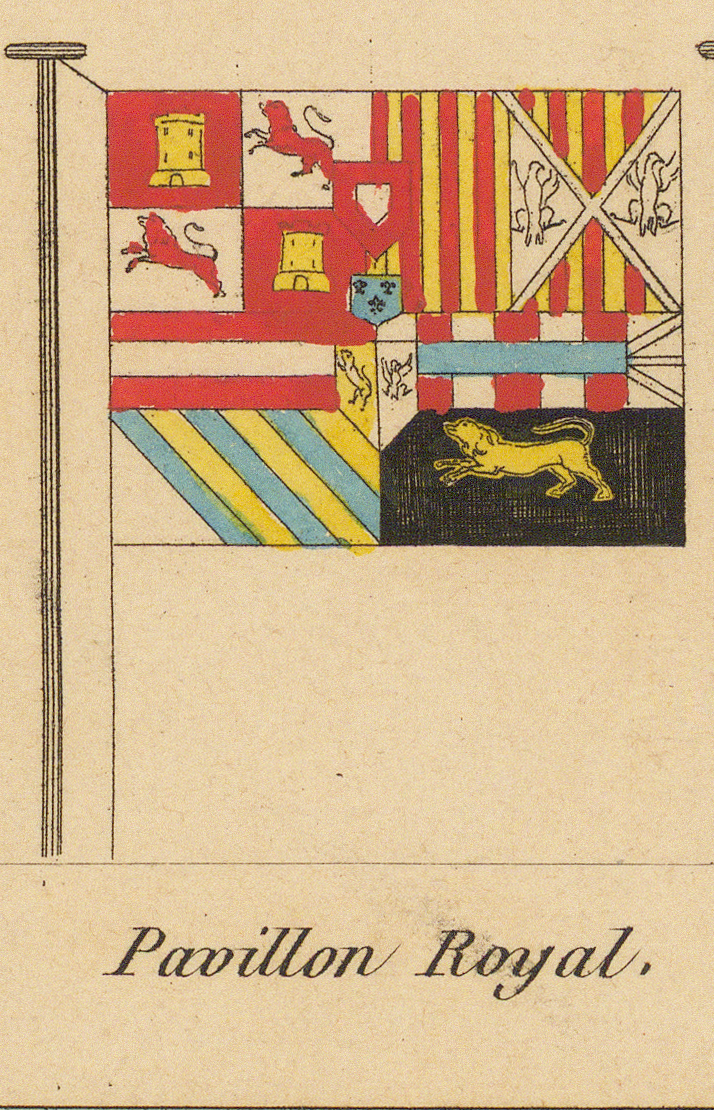
The earliest and finest quartered-sheet rendering in the collection, and the presumptive model, direct or shared, for the two American charts. The drawing is precise enough to read individual quarterings; the one place where it says less than its successors is the central escutcheon, discussed above. The sheet advertises itself as drawn from official documents, and its Spanish war and merchant ensigns are impeccable. Whatever source supplied this Pavillon Royal, the compiler treated it as authoritative.
Note: the c. 1864 Depiction
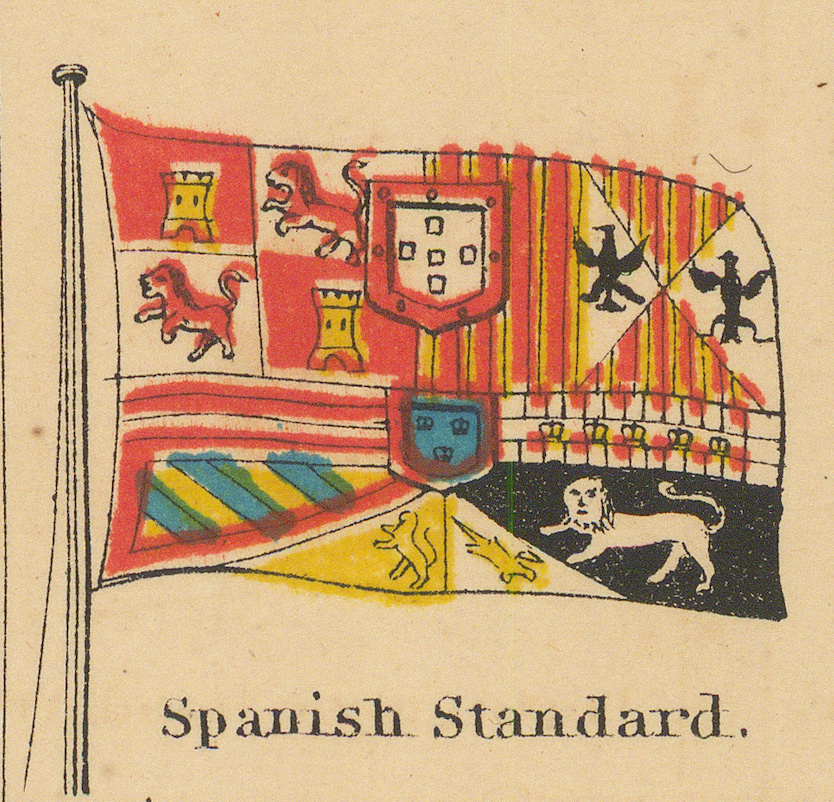
Johnson's chart repeats the composition quarter for quarter — Castile and León in the canton, the Aragon pales, the eagle saltires, the Burgundy bendy, the Brabant lion on black — and loses heraldic precision in the colour work, small crowns appearing along the compartment row. It is nevertheless the one sheet of the three that draws the central escutcheon as five shields rather than as a blank or a row of blocks. The correspondence with the 1837 sheet is close enough to establish a copying relationship, whether direct or through a common intermediary.
Note: the c. 1899 Depiction
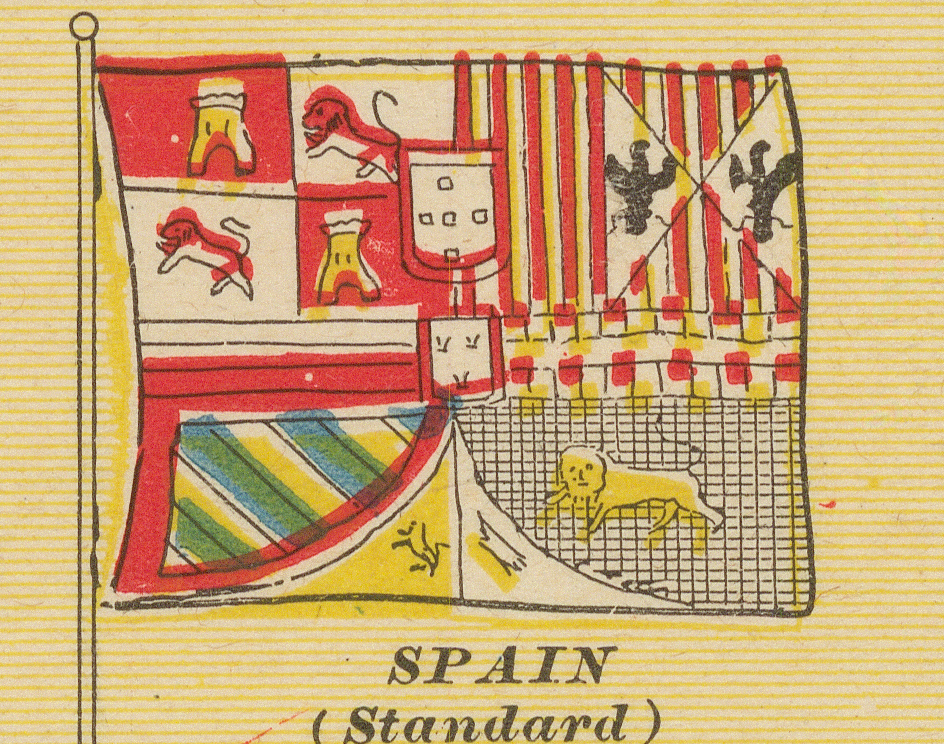
The chain's terminal sighting, printed on the eve of the Spanish–American War: the same quarters again and cruder still, the Portuguese shields reduced to squares and the Brabant quarter to cross-hatching, on a mass-market sheet whose Spanish war and merchant flags are otherwise conventional. Sixty years separate this panel from the 1837 model, with no sign that anyone checked the design against Spanish practice in between.
The Open Question
What document, chart, or actual flag stands at the head of this chain? Three candidates are worth testing: an early modern royal standard, since the Portugal-bearing greater arms point to c. 1580–1640; an eighteenth-century chart tradition not yet represented in this collection; or a genuine but poorly recorded ceremonial standard of later date. The next steps are to search earlier chart traditions for the same composition, and to compare the quarterings against dated versions of the Spanish greater arms. The c. 1720 panel above suggests where to start: the same quarterings, on a shield, more than a century before the earliest quartered sheet in the collection.
References
- Flaggen aller seefahrenden Potenzen und Nationen, panel Königl: Spanische, in the present collection.
- Pavillons et Cocardes des Principales Puissances du Globe, panel Espagne — Pavillon Royal, in the present collection.
- Johnson's New Chart of National Emblems, panel Spanish Standard., in the present collection.
- Flags of All Nations, panel Spain (Standard), in the present collection.
- Dated versions of the Spanish royal greater arms for comparison of quarterings. Full citations pending.
© Encyclopaediae. Open educational reference project.