East India Company Ensign
/vexillology/atlas/east_india_company
About
This page follows the striped ensign of the English East India Company through the sources collected in the Historical Flag Atlas. Few designs suit a copying study better. The ensign appears on almost every chart here old enough to have known the Company, and no two publishers draw it alike. Four depictions are catalogued below, running from the c. 1720 Homann sheet to the c. 1864 Johnson chart; the last two were printed after Company rule in India had already ended.
Status: Preliminary. The documented history below is assembled from general accounts; full citations remain to be secured.
Documented Flag History
The ensign was a field of red and white horizontal stripes with a canton at the upper hoist. The canton followed the English and then the British national flag: St George's cross in the seventeenth century, the Union flag after 1707, and the Union with St Patrick's saltire after 1801. The stripes were never fixed by regulation. Surviving records and depictions give counts from about nine to thirteen, so a disagreement between two charts may record real variation at sea as readily as careless copying.
The design is often called an ancestor, or a twin, of the early American flag: the Continental Colors of 1775 are the same composition, thirteen stripes under a British canton. The Company lost its trading monopolies in 1813 and 1833. After the rebellion of 1857 the Government of India Act 1858 ended its rule in India, and the Company itself was dissolved in 1874. An ensign printed after 1858 is therefore an archaism, whatever its caption claims.
Collected Depictions
| Source date | Source | Printed attribution | Study |
|---|---|---|---|
| c. 1720 | Flaggen aller seefahrenden Potenzen und Nationen | Engl: Ost-Indianische Compagnie | Note below |
| 1837 | Pavillons et Cocardes | Angleterre — Compagnie des Indes Orientales | Note below |
| c. 1863 | Pavillons des principales puissances | Angleterre — Indes orientales | Note below |
| c. 1864 | Johnson's New Chart of National Emblems | East India Company. | Note below |
Two further panels belong to the story without showing the English Company's ensign. The c. 1769 Encyclopédie plate gives figure 55 to the Pavillon des Indes orientales d'Ecosse, the flag of the Company of Scotland, defunct since 1707 and already marked for study in the source notes, and figure 78 to a Pavillon des Indes orientales bearing interlaced company letters whose company has not been identified. The c. 1720 sheet prints the Dutch East and West India Companies under their monograms. On charts of this kind the chartered companies stood among the nations as a matter of course.
Note: the c. 1720 Depiction
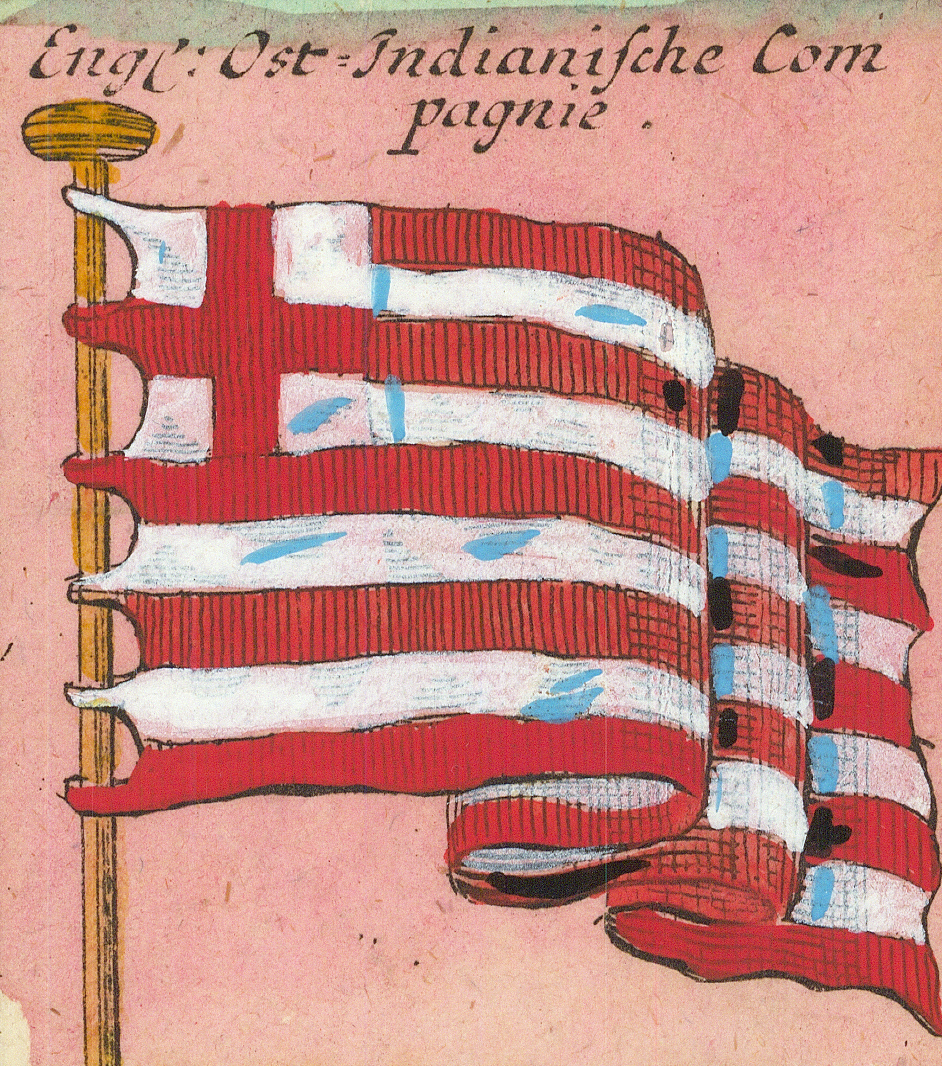
The Homann sheet draws nine stripes, red uppermost, under a St George's cross canton on white; the fly is drawn furled back on itself, so the count is easiest to take at the hoist. By the date assigned to the sheet the Union canton had been prescribed for more than a decade, since 1707. The St George form is therefore either an older model carried forward, which would be entirely in keeping with the sheet's methods elsewhere, or a record of how long the older form lasted at sea. Either way the panel preserves the seventeenth-century face of the ensign.
Note: the 1837 Depiction
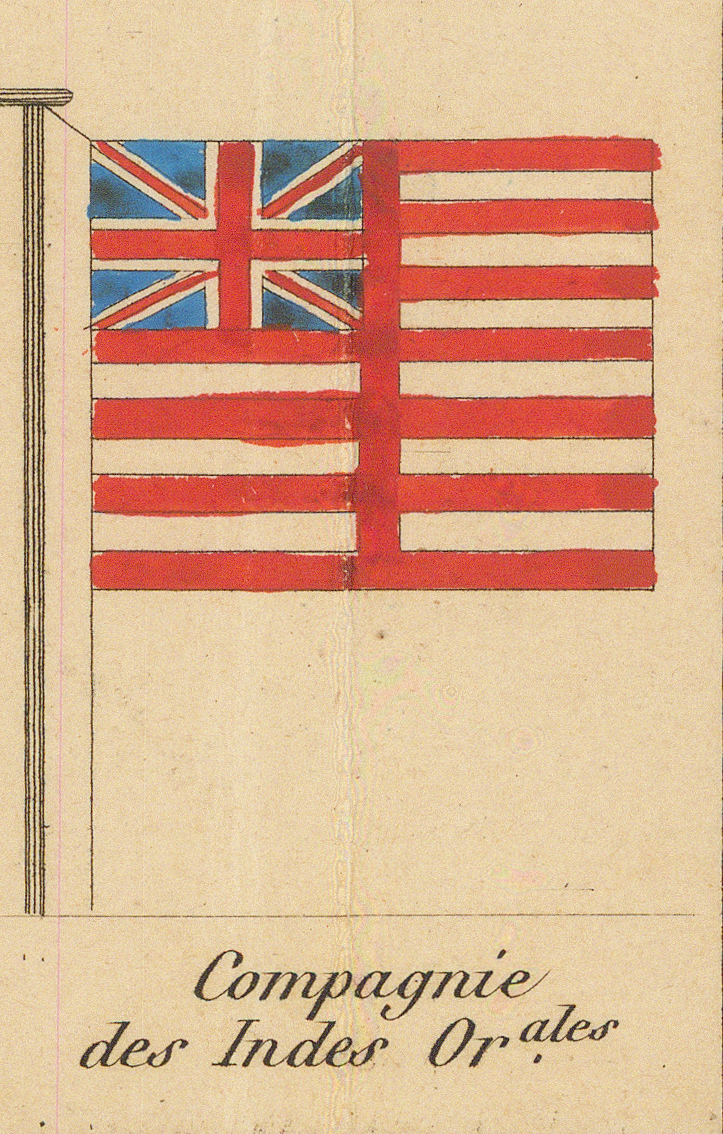
The 1837 Paris sheet, drawn d'après des documens officiels, gives the fullest form in the collection: thirteen stripes, red uppermost, under the post-1801 Union canton with St Patrick's saltire, the canton spanning the upper five stripes. In 1837 the Company still governed India, so this panel records a flag then in use, and its count matches the best-documented late form of the ensign.
Note: the c. 1863 Depiction
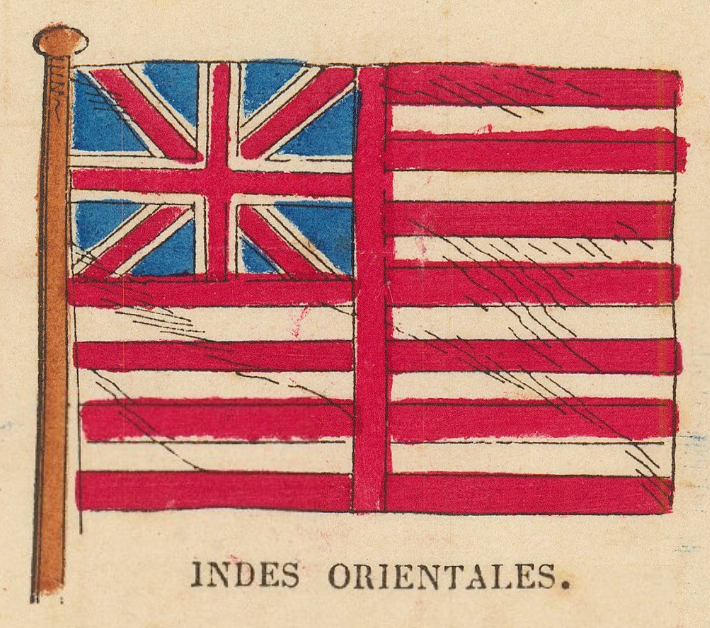
A generation after Andriveau-Goujon, a second Paris publisher prints the ensign again and prints it the same way: thirteen stripes, red uppermost, under the post-1801 Union canton, the canton once more spanning the upper five stripes. The two plates already stand in a documented relationship — their five French arrondissement panels repeat almost unchanged — and this panel is a second instance of the same debt.
What did change is the caption. The 1837 sheet names the Compagnie des Indes Orientales; this plate prints only Indes orientales, grouped under Angleterre. The Company had lost India five years earlier, and the word quietly went with it. The flag stayed on.
Note: the c. 1864 Depiction
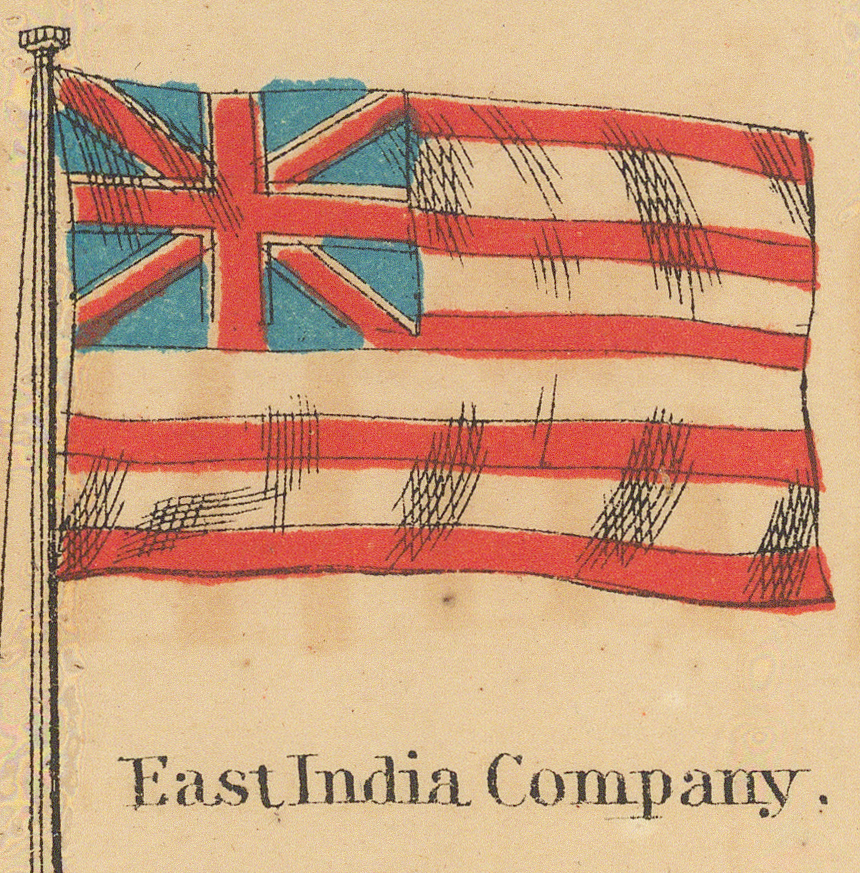
Johnson's chart gives the ensign nine stripes, red uppermost and lowermost, under a post-1801 Union canton that spans the upper five, and prints it among the British flags of the first row. Nine is a documented count, and the canton follows the same rule as on the Paris plates, so the panel is not a careless reduction of the thirteen-stripe form; it is a different model, and one that agrees with the Homann sheet of a century and a half earlier. Because the canton covers five stripes out of nine rather than five out of thirteen, it takes up more than half the depth of the flag, which is why the panel looks coarser than it is.
By the chart's copyright year the Company's rule in India had been over for five years. This is the collection's terminal sighting of the ensign, and it survives in print the way the Morocco “scissors” and the Persian lions survive elsewhere on the same sheet: by inheritance from older charts rather than from the sea.
Observations Across the Chain
Read in sequence, the four panels vary along two axes. The canton tracks the national flag: St George in c. 1720, the post-1801 Union in 1837, c. 1863, and c. 1864. It is the reliable dating element, and it also keeps its proportion, covering the upper five stripes in every panel that shows the Union.
The stripe count does not drift at random. It divides the four panels into two camps: nine on the Nuremberg sheet of c. 1720 and the New York chart of c. 1864, thirteen on both Paris sheets. Both counts fall inside the documented range of about nine to thirteen, so the division is better read as two surviving models than as one design decaying over time — and the two Paris plates fall on the same side of it, as they do in the arrondissement panels they share.
The sequence also cuts against the assumption that a later chart is a worse one. The fullest and most careful drawing is the 1837 sheet, which claimed official documents and still had a living Company to describe. What the two panels printed after 1858 lose is not the drawing but the label: the Paris plate drops the Company's name from a flag that had no other owner, and the Johnson chart keeps the name five years after Company rule had ended. The flags themselves stay within the documented range throughout. A fuller study would test these counts against surviving Company records and against the chart traditions not yet represented in this collection.
References
- Flaggen aller seefahrenden Potenzen und Nationen, panel Engl: Ost-Indianische Compagnie, in the present collection.
- Pavillons et Cocardes des Principales Puissances du Globe, panel Compagnie des Indes Orientales, in the present collection.
- Pavillons des principales puissances, panel Angleterre — Indes orientales, in the present collection.
- Johnson's New Chart of National Emblems, panel East India Company., in the present collection.
- General accounts of the Company ensign's canton changes (1707, 1801) and stripe variation, and of the end of Company rule (1858) and dissolution (1874). Full citations pending.
© Encyclopaediae. Open educational reference project.